

Pioneer Panda Pack 2.0 Review
A decade with one backpack, then the Panda turned up.

It’s fair to say I’m not the most versed on the subject of backpacks. But when Pioneer offered to send me one of their latest backpacks, along with some of their wallets, I couldn’t say no. I love a good backpack, and that’s why I’ve been so happy with my Everlane Modern backpack, which I’ve used for the better part of 10 years and featured in my personal EDC breakdown last year. But I must admit I have egg on my face. Although I’ve happily used my Everlane for years, it’s clear from only a short time using Pioneer’s revised Panda 2.0 that I’ve, for a better word, been missing out on a lot.
I’ve been using the Panda for a little over two months at this point, and even took it on a few trips across the UK, down to London. In this review, I’ll be breaking down the Panda, giving my honest opinion and answering the question: is it worth what is a pretty steep price tag?
- 1.Everything on the spec sheet (and a few things that aren’t)
- 2.From Kickstarter wallets to Million Mile bags
- 3.Mandarin 840: The Fabric That Sold Me
- 4.A pocket for (almost) everything
- 5.Mid-level comfort and a missing sternum strap
- 6.Other small gripes with the backpack
- 7.48 hours in London with nothing but the Panda
- 8.Final Verdict: Is the Pioneer Panda Worth $395?
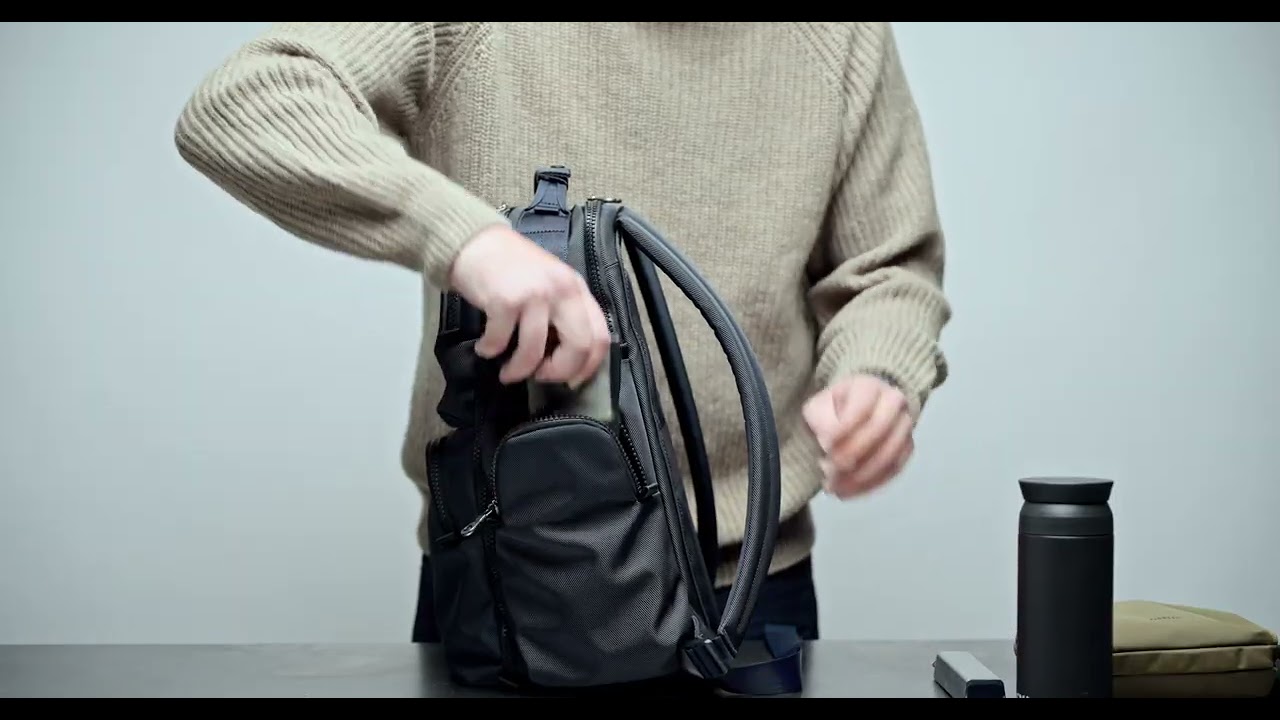
Pioneer’s official Panda Pack walkthrough
Everything on the spec sheet (and a few things that aren’t)
I can’t say I’m very versed on the tech specs of backpacks, but here is all the information I could find.
| Spec | Pioneer Panda Pack 2.0 | My thoughts |
|---|---|---|
| Capacity | 25L | Really decent capacity for an all-rounder backpack. |
| Dimensions | 17.5 x 11.5 x 8 in (15 in wide including the side pockets) | |
| Weight | 2.7 lb / 1.22 kg claimed | |
| Shell | Mandarin 840 twist-yarn ballistic nylon, DWR finish, waterproof membrane backing | Super interesting material. Pleasant texture, quality look and feel. |
| Lining | 3XD ripstop nylon | Thinner material on the inside but no less durable. I’ve used 3XD in some of Pioneer’s wallets and it’s great. |
| Zippers | YKK Vislon throughout | Large, but quality through and through. Loud though, so do not be opening this while the missus sleeps. |
| Laptop | Dedicated rear compartment with a suspended sleeve, fits up to a 16” MacBook Pro | My favorite aspect of this backpack. Perfect size, great padding, easy to access, comfortable. |
| Access | Full clamshell main compartment | Another standout feature. Means when I want to I can treat it as a suitcase. |
| Colors | Black, Navy, Forest | I have the black version. |
| Made in | Vietnam | Well done Vietnam, quality craftsmanship. |
| Warranty | Million Mile Lifetime Guarantee (defects in materials and workmanship) | A pretty bog standard warranty. |
| Price | $395 |


From Kickstarter wallets to Million Mile bags
Pioneer started life with a series of successful Kickstarter campaigns, mainly specializing in wallets (I recently reviewed their Pioneer Matter Bifold). But that was back in 2018, and nearly a decade later the brand has expanded further into the everyday carry space, producing a variety of goods from slings and travel pouches to, of course, backpacks. The San Francisco brand was founded by Henry Lefens, who previously designed bags for Black Diamond and Levi’s, and its Million Mile bag line launched in early 2024 with the Duration, the Savant and the Panda, the largest of the three. The version I’m reviewing here is the Panda 2.0, which landed in April 2025.
Pioneer prides itself on its use of some pretty unique materials. Whether it’s a wallet or a backpack, you can be assured you’re getting something that uses a so-called “tactical material” that isn’t common and you’ve probably never seen before. This includes the likes of 3XD, 10XD and Baby Ballistic, which can simply be summed up as hybrid materials combining the properties of better-known materials such as ripstop nylon, ballistic nylon and UHMWPE (the same fiber family as Dyneema).
Mandarin 840: The Fabric That Sold Me
Pioneer was built on its unusual and unique range of materials, with arguably odd names like 10XD or Baby Ballistic. But having reviewed multiple different wallets from the brand, it’s fair to say I was excited to try their own Mandarin 840, a twist-yarn ballistic nylon which, to quote myself from the beginning of this article, is similar to standard ballistic nylon or X-Pac, just better looking and with a nicer, more premium feel.
It boasts advantages such as abrasion resistance, a durable water repellent finish and a waterproof membrane backing, with the latter being the one I was most skeptical about and put to the test.
I wanted to see whether the water would bead off (which is preferable) as opposed to getting absorbed. The results are pretty boring and what you’d expect. Water won’t penetrate the bag at all, which is fantastic, but it will get absorbed into the fabric, standard stuff. Piggybacking off this is worth knowing: the zippers aren’t sealed water-resistant ones, so in a proper downpour they’re the weak point rather than the fabric.

A pocket for (almost) everything
Large, quality YKK Vislon zippers are included on every pocket of this backpack, a testament to the attention to detail on offer. First up are the two larger compartments: the main compartment that opens fully, and a dedicated laptop compartment at the back with a suspended sleeve. That suspended sleeve is one of the 2.0 updates, and it keeps your laptop off the bottom of the bag rather than taking the hit every time you put it down.

Then there are the two smaller side pockets. I would call these drinks pockets, but at the same time they’re too small to hold anything bigger than a 0.5L bottle or an 18 oz Hydro Flask with the zip closed, which is smaller than the 32 oz Nalgenes and Stanleys plenty of people carry. Anything taller has to ride with the zip open, which is frankly annoying and not very secure. They also aren’t exactly large enough, or segmented enough, for anything else useful. Storing food is what I mainly use these slots for.


The final two are the medium-sized pockets on the front. Lovely sizes, with segmentation within, and because they have their own volume they don’t eat into the space in the main compartment. The lower one also has a removable key leash.


Round the back there’s a luggage pass-through for sliding the Panda over the handle of a rolling suitcase, and Pioneer also includes a removable luggage tag, which is a nice addition and shows some lovely attention to detail.


Mid-level comfort and a missing sternum strap
Comfort-wise, I’d put the Panda at mid-level. I think it’s the more rigid material that makes for a slightly more uncomfortable carry experience. Despite Pioneer making the padding denser for the 2.0, I still found the shoulder strap’s 10mm foam a little firm and stiff, not giving much away in terms of comfort. There’s also the lack of a sternum strap, no load lifters and no hip belt, which I feel would all be great additions to this backpack. Again, this has pros and cons, and although it isn’t the most comfortable thing in the world, the pros sure do outweigh the cons.

Other small gripes with the backpack
Beyond comfort, a few other points worth considering but nothing too terrible. The front pockets are quick to reach, but that also means they’re quick for someone else to reach, and there’s no hidden pocket for a passport. The chunky Vislon zippers are smooth but noisy, although this is actually a positive in my opinion as it can act as a deterrent to potential pickpockets.
And something I learned from some others discussing the Panda. If you fly budget airlines in Europe (like I do frequently), at 17.5 inches tall it’s over the free under-seat allowance on the likes of Ryanair and Wizz Air (40 x 30 x 20 cm). Now I’m quite lucky that I didn’t decide to take this backpack with me on my most recent trip to the Netherlands.
48 hours in London with nothing but the Panda
I had the opportunity to use the Panda on a quick trip to London, where it was my only bag for the two-day visit. I won’t bore you with the details of my trip, but what I can tell you is the Panda excelled in the vast majority of metrics I tested it on. Long term comfort was fine. What surprised me most was its durability over this short period. I wasn’t exactly careful with the backpack and after a proper inspection after the trip it remained looking brand new. Even now, two months later and with near daily use of the Panda, it really is in pristine condition, and that’s testament to the material choice of Pioneer. Great stuff.
One thing that stood out straight away is that the material retains its shape really well, which means you can put it down, pick it up, and open and close it without the material collapsing in on itself. It stands up on its own whether it’s loaded or empty, which is one of the most praised things about this bag, and rightly so. The segmentation of the backpack is clever. You never forget where anything is, while never having to worry about things rattling around inside.

Final Verdict: Is the Pioneer Panda Worth $395?
The Panda from Pioneer has given me a sudden realization that a backpack can be more. Its clever all-round design, to me, makes it perfect for any occasion, whether that’s a coffee shop laptop day or a weekend trip to see the in-laws. In my case, my trip to London was only made better by the Panda, with the two separate compartments for my laptop and my clothes meaning I could separate my work and personal life, so to speak.
As always, value is in the eye of the beholder. At $395 the Panda isn’t cheap, but it is backed by Pioneer’s Million Mile lifetime guarantee against defects, and as far as it being the first backpack I’ve ever reviewed, I must say I was impressed. As to whether it has replaced my 10 year old Everlane backpack? Well, it really is a no-brainer. The Pioneer Panda has opened my eyes to what a backpack could be, but also given me insights into what makes a good backpack. For more on the Panda, including the current price and the full spec, check it out at Pioneer below.
Check Backpack PriceOur Verdict: TL;DR
What We Like
- Epic material. Perfectly balances shape, form, function and durability.
- Holds its shape, so it stands up on its own, loaded or empty.
- The laptop compartment and main compartment complement each other brilliantly.
What We Don't Like
- Side pockets are too small for a standard-sized water bottle.
- Mid-level comfort, and no sternum strap.
- At $395, it’s quite the investment.